
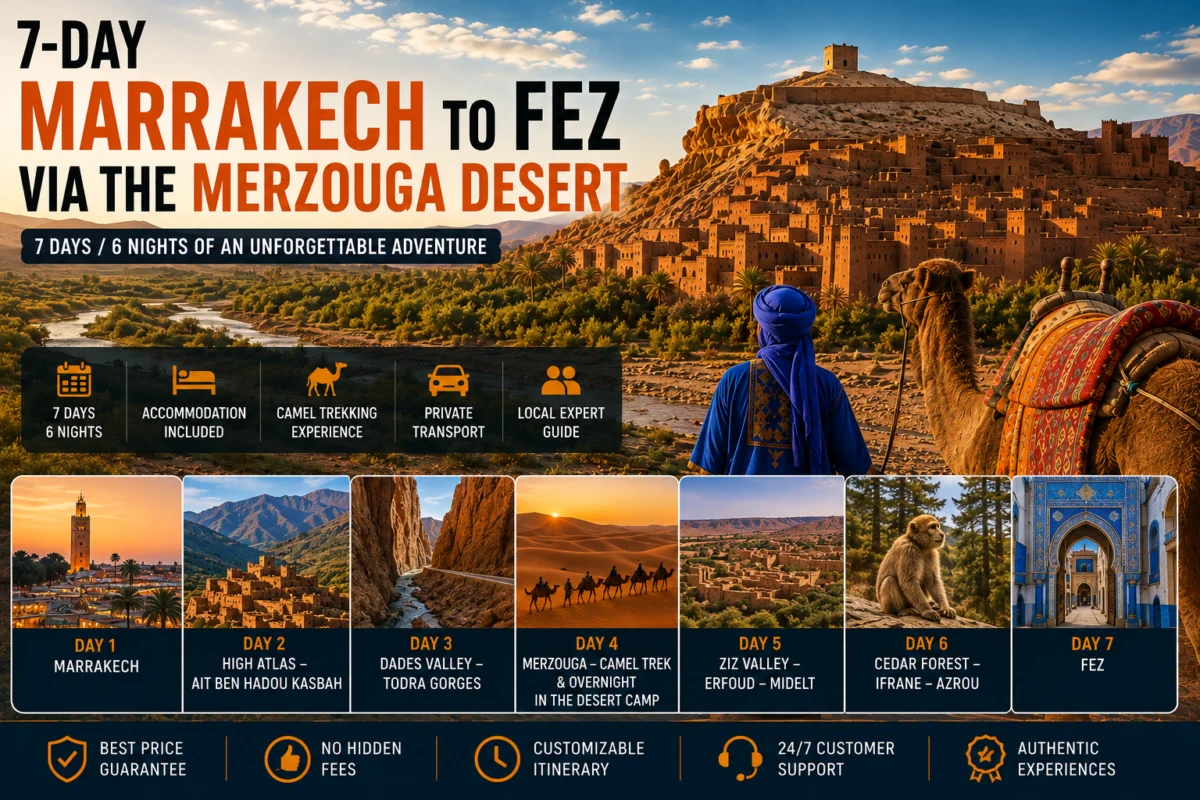
Marrakech to Fes Desert Tour via Merzouga: 3-Day Route
The Marrakech to Fes desert tour is a practical way to travel between two of Morocco’s most important cities while discovering the Sahara. Instead of taking a direct transfer, the route crosses the High Atlas, Ait Ben Haddou, Ouarzazate, the Dades Valley, Todra Gorge and Merzouga.
The classic itinerary lasts three days. In addition, it combines scenic roads, traditional architecture, oases, Amazigh villages and the dunes of Erg Chebbi. The Merzouga experience is often the centerpiece of the journey, with a camel ride, sunset and a night at a Sahara desert camp.
This type of journey is part of the Morocco tours that combine heritage, nature and desert landscapes. Likewise, you can travel on a shared tour or choose a private option. If you are specifically looking for this route, explore the 3-Day Desert Tour from Marrakech to Fes via Merzouga.
Why Choose a Marrakech to Fes Route Through the Sahara?
Marrakech and Fes are separated by a considerable journey. Therefore, dividing the route over several days turns the transfer into an important part of your trip. Instead of simply moving from one city to another, you can discover some of southern and inland Morocco’s major landscapes.
Moreover, the itinerary avoids having to return to Marrakech after visiting Merzouga. This is particularly useful if your journey continues through Fes or northern Morocco. At the same time, the route combines mountains, valleys, gorges and the Sahara.
Travelers who prefer greater flexibility can choose one of the private Morocco tours. A private format provides an exclusive vehicle and greater flexibility at stops. On the other hand, shared departures can suit travelers who prefer to follow a more established schedule.
Day 1: Marrakech to the Dades Valley
The first day begins in Marrakech. Depending on your booked program, pickup may take place at your riad, hotel or another agreed location. Shortly after leaving the city, the road begins climbing toward the High Atlas.
The landscape changes quickly. The streets of Marrakech give way to mountains, valleys and rural communities. In addition, stops can be made during the journey to rest and enjoy panoramic viewpoints.
The High Atlas and Tizi N’Tichka
One of the most scenic sections is the crossing of Tizi N’Tichka. This mountain pass reaches an elevation of more than 2,200 meters. It also connects Marrakech with the regions on the other side of the High Atlas.
The road crosses a mountainous environment that changes with the seasons. During winter, some peaks may be covered with snow. At other times of year, the area’s characteristic ochre and reddish colors dominate the scenery.
Furthermore, the journey offers views of villages traditionally constructed from earth, adobe and stone. Travelers interested in spending more time in this region can explore the tours from Marrakech and the Atlas.
Ait Ben Haddou: Heritage and Southern Architecture
After crossing the High Atlas, the journey continues toward Ait Ben Haddou. This historic ksar is designated as a UNESCO World Heritage Site. Therefore, it is one of the route’s most important cultural stops.
Its earthen houses and other structures showcase traditional building techniques from southern Morocco. In addition, the higher areas of the settlement offer expansive views of the surrounding landscape.
A visit gives you the opportunity to walk through the fortified settlement and discover small craft shops. Ait Ben Haddou has also served as a location for various film and television productions. Frequently mentioned examples include Gladiator, The Mummy and Game of Thrones.
If you want to explore the area without continuing to the Sahara, you can take an Ouarzazate and Ait Ben Haddou day trip from Marrakech.
Ouarzazate: Gateway to Southern Morocco
After Ait Ben Haddou, the itinerary continues toward Ouarzazate. The city occupies a strategic position between the High Atlas and the routes farther south. As a result, it is frequently included on Sahara tours.
The Kasbah of Taourirt is among its points of interest. In addition, the area is known for its film studios and the numerous productions filmed in the surrounding region.
Route of the Kasbahs, Skoura and the Valley of Roses
As you continue toward Dades, earthen fortresses, palm groves and small oases appear along the route. This landscape forms part of the famous Route of a Thousand Kasbahs. Some buildings are better preserved than others, but together they illustrate the region’s architectural heritage.
Farther along, the road passes the Skoura oasis. Its palm trees provide a striking contrast with the arid surroundings. Afterwards, the route continues toward Kelaat M’Gouna and the area known as the Valley of Roses.
This region is associated with the production of rose water, perfumes, soaps and oils. During spring, flowering roses give the valley a different appearance.
Arrival in the Dades Valley
The first day finishes in the Dades Valley. The river helps sustain orchards and green areas between reddish mountains. As a result, the contrast between vegetation and rock is one of the valley’s recognizable features.
Depending on the route, you may also stop at a viewpoint overlooking the winding road and surrounding landscape. Afterwards, the day usually ends at a riad or hotel in the area.
From here, the landscape begins its transition toward the Sahara. The next day leads to Merzouga, one of Morocco’s best-known destinations for a Sahara Desert tour.
Day 2: Dades Valley to Merzouga
After breakfast, the second day’s journey continues east. This day includes some of the route’s most striking natural scenery. In addition, it finishes beside the dunes of Erg Chebbi.
Todra Gorge
Todra Gorge is one of southern Morocco’s best-known canyons. At some points, its rocky walls rise more than 300 meters. A watercourse also runs through the lower section of the gorge.
A stop allows you to walk between the rock walls and appreciate the landscape at a slower pace. The area also attracts hikers and travelers interested in nature. For this reason, it is frequently included on overland routes between Dades and Merzouga.
Tinghir and Its Palm Grove
The route also passes through Tinghir. The town is surrounded by an extensive palm grove supported by the area’s river system. From several viewpoints, you can see palms, agricultural fields and settlements against the mountainous landscape.
Moreover, the valley produces dates, olives and other traditional crops. Therefore, the journey provides another perspective on agricultural life in Morocco’s pre-Saharan regions.
Erfoud and Its Fossils
Farther along, the route reaches Erfoud, a town closely associated with the region’s fossil heritage. Marine fossils can be found preserved within local rock.
Some itineraries include a visit to specialist workshops. There, artisans use fossil-bearing stone to produce decorative objects and other pieces. Therefore, this stop combines geology with local craftsmanship.
Rissani: Market and Local Food
Before reaching Merzouga, some itineraries pass through Rissani. The town has considerable regional history and retains a traditional market.
When your visit coincides with a market day, you may see stalls selling spices, textiles, crafts and dates. In addition, Rissani is known for medfouna, a traditional southern dish that is often described as Berber pizza.
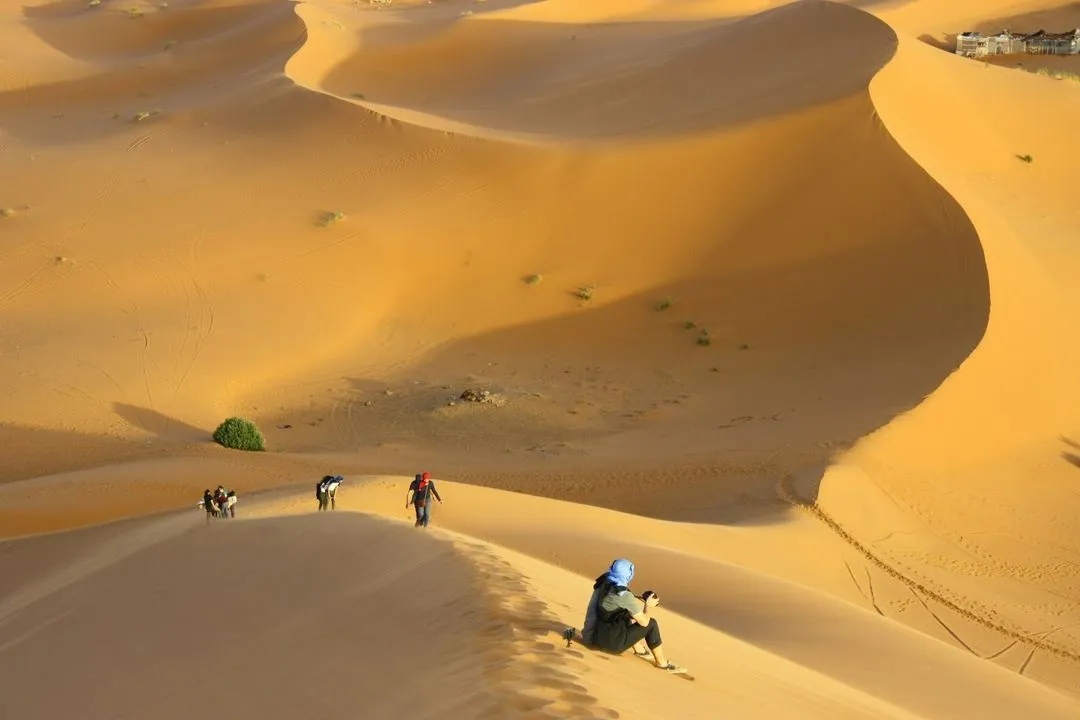
Arrival in Merzouga and Erg Chebbi
During the afternoon, the dunes of Erg Chebbi come into view. Merzouga lies beside this extensive dune field and serves as a major base for exploring the Moroccan Sahara. For official information about the region, you can also consult the destination guide for Errachidia, Midelt and Merzouga.
Some Erg Chebbi dunes can exceed 150 meters in height. Therefore, the contrast with the valleys and mountains seen earlier in the journey can be particularly striking.
Before heading to the camp, it is useful to prepare only what you need for the night. Depending on the accommodation and program, your main luggage may remain at a property in Merzouga.
Camel Ride Across the Dunes
The camel ride usually begins in the late afternoon. This allows the journey across the dunes to coincide with the evening light. In addition, there is generally time to stop and enjoy the landscape.
The slow pace makes it easier to appreciate the silence and shapes of the dunes. However, traveling by camel is not the only possibility. Some private itineraries provide a 4×4 transfer to the camp instead.
Sunset at Erg Chebbi
As sunset approaches, the changing light gradually transforms the colors of the sand. Golden tones can shift toward orange and red. As a result, this part of the day is particularly popular with travelers interested in Sahara photography.
Keep in mind that sunset conditions vary from day to day. Therefore, arrival times at the dunes need to suit both the itinerary and season.
Night at a Sahara Desert Camp
After exploring the dunes, the day ends at a desert camp. Depending on the option booked, accommodation may be standard or offer a higher level of comfort.
The evening usually includes dinner and mint tea. In addition, some programs feature traditional music around a fire. The area’s low levels of urban lighting can also make it suitable for viewing the night sky when conditions allow.
Before booking, it is advisable to review the accommodation details carefully. Terms such as “standard” and “luxury” can refer to different services depending on the operator. Therefore, check the tent type, bathroom facilities and other included services.
Day 3: Merzouga to Fes
The third day begins early for travelers who want to see the sunrise. The first rays of sunlight gradually change the appearance of Erg Chebbi. Moreover, the early morning offers a different atmosphere from the previous evening.
Afterwards, you return to the camp or agreed meeting point for breakfast and to prepare your luggage. The long journey toward Fes then begins through the Ziz Valley and Middle Atlas.
Return from the Dunes to Merzouga
The return can be made by camel or 4×4 vehicle, depending on the option booked. Once you meet your driver, the journey north begins.
The scenery changes again during the day. Within several hours, dunes and arid areas give way to oases, mountains and eventually forests.
Ziz Valley
One of the first notable areas is the Ziz Valley. The oasis is characterized by date palms and traditional settlements. In addition, several viewpoints reveal the contrast between the green valley and arid surrounding terrain.
The Ziz River plays an important role in regional agriculture. Therefore, the valley provides another example of how access to water shapes settlements and farming in this part of Morocco.
Midelt and the Route Toward the Middle Atlas
Later, the route reaches Midelt, situated among Morocco’s Atlas mountain systems. The town is known for its apples and surrounding mountain landscapes.
Midelt frequently serves as a rest point on journeys between Fes and the Sahara. As a result, it can be a suitable place to stop for lunch before continuing.
Azrou Cedar Forests
After Midelt, the journey enters the landscapes of the Middle Atlas. The forests near Azrou are known for their cedar trees and the presence of Barbary macaques.
If you encounter animals during a stop, it is advisable to maintain an appropriate distance and avoid interfering with their behavior. Furthermore, the forest environment creates an obvious contrast with Erg Chebbi.
Ifrane and the Final Stage to Fes
The next common stop is Ifrane. Its architecture and landscaped spaces look noticeably different from towns farther south. For that reason, it is popularly known as the “Switzerland of Morocco.”
After a short stop, the journey continues toward Fes. Arrival marks the end of your route between Marrakech and the Sahara.
Arrival in Fes: End of the Marrakech to Sahara Tour
The three-day itinerary finishes upon arrival in Fes. Along the way, the route crosses kasbahs, mountains, oases, gorges, rural communities and the dunes of Merzouga. As a result, the journey between Marrakech and Fes becomes a tour through several of inland Morocco’s distinctive landscapes.
If your journey continues from the city, you can explore the tours from Fes. There is also a wider selection of Tours From Fes with itineraries of different lengths.
Is a 3, 4 or 5-Day Tour Better?
Three days are suitable if you want to connect Marrakech with Fes and have limited time. However, the itinerary includes substantial time on the road. Therefore, travelers who prefer a slower journey can consider a longer route.
- 3 days: Covers the main stops and an Erg Chebbi desert experience.
- 4 days: Provides more time to divide the journey and explore the route at a slower pace.
- 5 days: Offers even more time for landscapes and intermediate stops.
In addition to the three-day option, you can compare the 4-Day Desert Tour from Marrakech to Fes via Merzouga and the 5-Day Desert Tour from Marrakech to Fes via Merzouga. This allows you to choose the pace that best suits your trip.
Private or Shared Tour?
The choice depends mainly on your preferred travel style. A private tour makes it easier to adjust stops and provides an exclusive vehicle. In addition, this format can work well for couples, families and groups of friends.
On the other hand, a shared tour normally follows a more defined program. Before booking either option, review the accommodation, meals, guides, entrance fees and activities included.
Alternatives to the Marrakech–Merzouga–Fes Tour
Not every traveler follows the same route through Morocco. For example, if you only have two days from Marrakech, you can consider a 2-day Zagora desert tour from Marrakech. Zagora offers a different desert route and may suit shorter itineraries.
Likewise, travelers starting in Fes can complete the journey in the opposite direction on the 3-Day Desert Tour from Fes to Marrakech. For a less concentrated itinerary, the 4-Day Desert Tour from Fes to Marrakech is another option.
More Desert Tours from Fes
Fes is another important departure point for traveling toward Merzouga. Available options range from short desert journeys to longer itineraries combining the Sahara with Morocco’s Imperial Cities.
- 2-day desert tour from Fes to Marrakech
- 2-day Merzouga desert tour from Fes
- 3-day desert tour from Fes to Marrakech
- 3-day Merzouga desert loop from Fes
- 4-day desert tour from Fes to Marrakech
- 4-day Merzouga desert and canyons tour from Fes
- 5-day desert tour from Fes to Marrakech via Merzouga
- 7-day desert and Imperial Cities tour from Fes
- 10-day Grand Imperial and Desert tour from Fes
For travelers who want to combine urban heritage and the Sahara in one journey, there is also the 7-Day Desert & Imperial Cities Loop Tour from Fes.
Other Starting Points for Morocco Tours
Although this itinerary begins in Marrakech, you can also organize journeys from other cities. For example, travelers arriving in Casablanca can explore Tours From Casablanca. A shorter option is the 5-Day Desert & Imperial Highlights Tour from Casablanca.
For a longer journey from the same city, the 9-Day Grand Sahara & Imperial Cities Loop from Casablanca combines the Sahara with Morocco’s Imperial Cities.
Tangier is another possible gateway. Travelers beginning in northern Morocco can compare Tours From Tangier. Available routes include the 5-Day Desert Tour from Tangier to Marrakech via Merzouga.
Day Trips to Complement Your Journey
If you have extra days in Marrakech, you can complement your Sahara itinerary with shorter excursions. The day trips from Marrakech provide opportunities to discover other landscapes without taking another long circuit.
Atlas Mountains
The Atlas offers villages, walking trails and mountain scenery. Therefore, a dedicated excursion can be useful if you want more time in the region crossed during the first day of the desert journey.
Ourika Valley
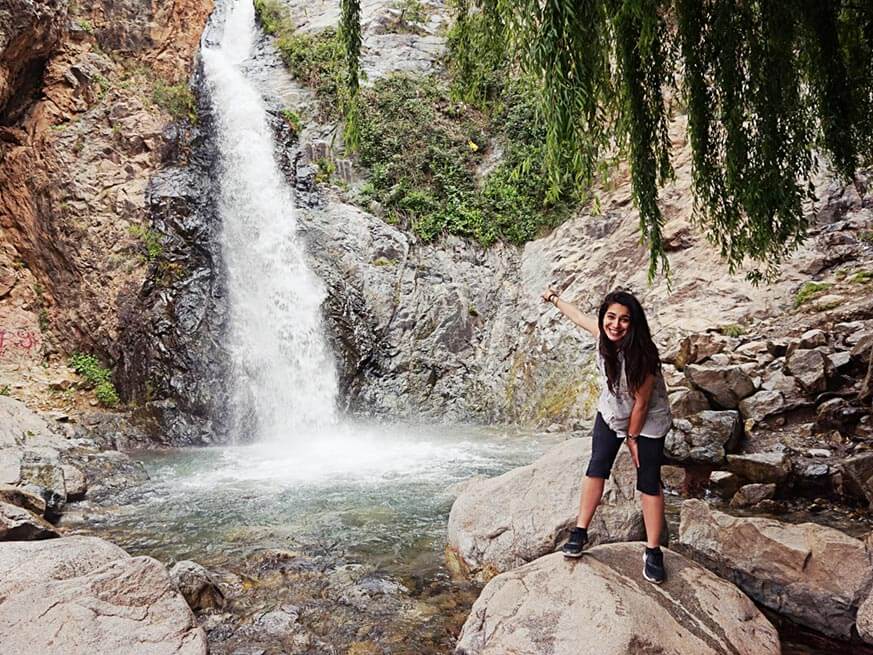
The Ourika Valley combines Atlas scenery, riverside areas and small waterfalls. In addition, it can provide a change of atmosphere after exploring the medinas or before beginning a longer tour.
Ouzoud Waterfalls
The Ouzoud Waterfalls are another natural destination for a day trip from Marrakech. The area is also known for the presence of macaques. If you encounter them, it is advisable to observe the animals without interfering with their behavior.
Essaouira
Essaouira combines the coast, cultural heritage and a UNESCO-listed medina. In addition, its Atlantic setting provides a clear contrast with Marrakech and the Sahara. Travelers with a free day can consider an Essaouira Day Trip from Marrakech.
Agafay Desert
Agafay may appeal to travelers who want to include an arid landscape during a stay in Marrakech. Depending on the selected program, activities may include camel rides, quad biking, dinner or camp accommodation. Before booking, check exactly which services are included.
Practical Tips for the Marrakech to Fes Desert Tour
- Wear comfortable clothes: You will spend part of the journey in a vehicle and walk during several stops.
- Bring suitable footwear: Good shoes are useful for Ait Ben Haddou, the gorges and uneven terrain.
- Protect yourself from the sun: Bring sunscreen, sunglasses and a hat.
- Prepare for temperature changes: During winter, a jacket can be useful, particularly for desert nights.
- Pack a small overnight bag: It may be more practical for the desert camp than carrying all your luggage.
- Check the inclusions: Confirm meals, accommodation, entrance fees, local guides, camel rides and 4×4 transfers.
- Respect local customs: Be considerate when visiting villages, markets and rural communities.
- Protect the environment: Avoid leaving waste and respect both natural landscapes and wildlife.
Frequently Asked Questions About the Marrakech to Fes Desert Tour via Merzouga
How many days do I need to travel from Marrakech to Fes through the desert?
The itinerary described in this guide lasts three days. It crosses the High Atlas and visits Ait Ben Haddou, Dades and Merzouga before continuing to Fes. However, four- and five-day alternatives are available for travelers who want more time.
Does the Marrakech to Fes tour go through Merzouga?
Yes. This route crosses southeastern Morocco and arrives in Merzouga on the second day. Erg Chebbi’s dunes and many Sahara desert camps are located in this area.
Where do you stay overnight during the tour?
The itinerary described includes a first night in the Dades region and another in the Merzouga desert. The specific hotel, riad or camp depends on the option booked.
Can I reach the desert camp without riding a camel?
Some private tours offer a 4×4 transfer as an alternative. However, you should confirm this option with the operator before booking.
What is the difference between Zagora and Merzouga?
They are different destinations. The route described here travels to Merzouga and Erg Chebbi. Zagora, by comparison, is presented as an alternative for a two-day itinerary from Marrakech.
Can I travel the route in the opposite direction?
Yes. There are itineraries from Fes to Marrakech that travel through the Sahara. In addition, both three- and four-day options are available depending on your preferred pace.
What should I check before booking?
Review the vehicle type, accommodation, included meals and entrance fees. In addition, confirm the desert camp services, camel ride, 4×4 transfer and any optional activities.
Does the tour finish in Fes?
Yes. The three-day itinerary described in this guide ends in Fes after crossing the Ziz Valley, Midelt, the Middle Atlas, Azrou and Ifrane.
Conclusion: Is the Marrakech to Fes Desert Tour Worth It?
The Marrakech to Fes tour via Merzouga is particularly useful for travelers who want to combine intercity travel with a Sahara experience. In three days, the route connects the High Atlas, Ait Ben Haddou, Ouarzazate, Dades, Todra and Erg Chebbi before continuing to Fes.
However, the three-day option has an active pace and includes several road journeys. Therefore, if you have more time, a four- or five-day itinerary can provide a more relaxed experience.
Whatever duration you choose, it is important to compare the inclusions and accommodation carefully. This will help you choose a route suited to your pace, priorities and preferred way of traveling through Morocco.
Marrakech, Fes, Merzouga, Erg Chebbi, High Atlas, Ait Ben Haddou, Ouarzazate, Dades Valley, Todra Gorge, Sahara
Going the other way? Read our guide from Fes to Marrakech.
Related tours and guides
Trusted sources: Ouarzazate (Moroccan National Tourist Office)
Plan this trip with a local team
Tell us your dates and group size, and we will reply with a clear quote for a private tour.
Request a quote | Chat on WhatsApp | See our tours from Marrakech