
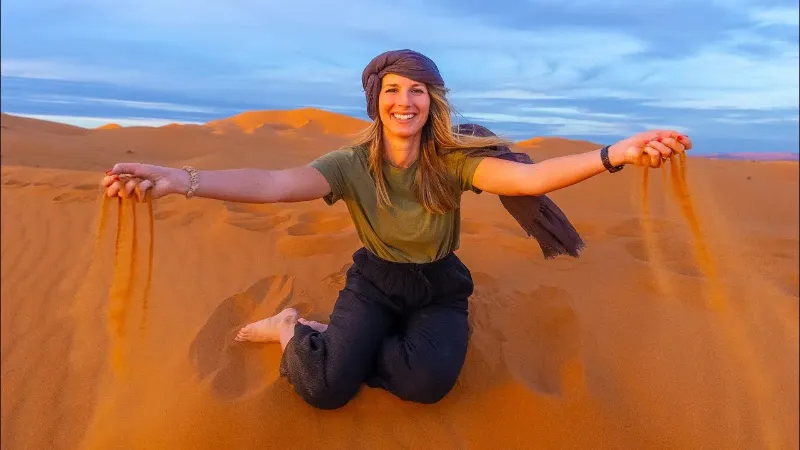
Ask ten travelers what they loved most about Morocco and you will get ten different answers. One will talk about the hush of the Sahara at 5 a.m., dunes turning pink before the sun clears the horizon. Another will describe getting lost — happily — in a medina alley in Fes, following the sound of a coppersmith’s hammer. A third will remember a glass of mint tea on a rooftop in Essaouira, watching gulls circle the old Portuguese ramparts.
That range is exactly why “the best Morocco tour” isn’t one itinerary — it’s a match between a traveler and a route. This guide breaks down the best Morocco tours 2026 has to offer by region, by trip length, and by travel style, so you can figure out which one is actually right for you before you book anything from our full Morocco tour packages.
Start With the Landscape, Not the Itinerary
Morocco packs an unusual amount of geography into a single country, and most tour decisions come down to how much of it you want to see. Four regions do most of the work in any well-built itinerary.
The Sahara and the Erg Chebbi Dunes
Merzouga sits on the edge of Erg Chebbi, a sand sea that stretches roughly 28 kilometers north to south, with dunes climbing to around 150 meters at their tallest points — among the highest in the country. This is the Morocco of postcards: camel treks at dusk, a Berber camp under an unpolluted sky, and a silence that’s hard to describe until you’ve sat in it. Several of our tours from Marrakech are built specifically around this stretch of desert.
The High Atlas and the Kasbah Road
Getting to the desert from Marrakech usually means crossing the Tizi n’Tichka pass, which tops out at roughly 2,260 meters — the highest major mountain pass in North Africa. The road down the other side runs through a string of earthen kasbahs, the Draa and Dades valleys, and the dramatic limestone walls of Todra Gorge. A stop at the UNESCO-listed Ait Ben Haddou and Ouarzazate day trip is where most travelers say this drive really earns its reputation.
The Imperial Cities
Casablanca, Rabat, Meknes, Fes, and Marrakech each served as a seat of power at different points in Moroccan history, and each has its own personality — the official Moroccan National Tourist Office is a good place to see how differently each city is positioned. Fes el-Bali, the old walled quarter of Fes, is home to roughly 156,000 residents and holds the Guinness World Record for the largest car-free urban area by population — everything moves by foot, handcart, or donkey inside its walls. Outside Meknes, the Roman ruins of Volubilis add a completely different historical layer, with mosaics and standing arches dating back nearly two thousand years. Our tours from Fes and tours from Casablanca cover these cities in different orders depending on where you land.
The Atlantic Coast
Essaouira balances the desert-and-mountains itinerary with sea air. Its medina became a UNESCO World Heritage Site in 2001, built on 18th-century fortifications designed under Sultan Mohammed III after an earlier Portuguese fort fell in 1510. Today it’s known for grilled seafood, laid-back surf culture, and the Gnaoua World Music Festival, which draws hundreds of thousands of visitors each June — see the official Essaouira-Mogador guide for more on the town itself.

Best Morocco Tours 2027, Sorted by How Much Time You Have
Once you know which landscapes pull at you, trip length narrows the field fast. Here’s how the most popular options break down, and where to see the full range in our Morocco tour packages.
3–4 Days: A Focused Desert Escape
If you’re short on time or bolting a desert trip onto a longer trip elsewhere, a 3 or 4-day loop from Marrakech to Merzouga and back (or onward to Fes) covers the essentials: the Tizi n’Tichka crossing, Ait Ben Haddou, a night in a desert camp, and a camel trek at sunrise or sunset. It’s compact, but it hits every landscape described above. Browse the short options among our tours from Marrakech.
7–8 Days: Imperial Cities Meet the Desert
A week gives you room to combine two or three imperial cities with a proper desert stop, rather than choosing between culture and dunes. This is the sweet spot for first-time visitors who want a genuine overview without feeling rushed — see the week-long routes under tours from Casablanca.
10–12 Days: The Full Circuit
Ten to twelve days is enough to add Chefchaouen’s blue-washed lanes, a coastal stop in Essaouira, or a slower pass through the Atlas foothills — the kind of trip where you’re not sprinting between highlights but actually settling into each place for a night or two.
12–14 Days: Women-Only and Slow-Travel Itineraries
Longer, small-group formats — including women-only departures — tend to build in cooking classes with local women, visits to female-run argan oil and weaving cooperatives, and a hammam afternoon, alongside the standard desert and city stops. Moreover, the extra days go toward connection rather than coverage.
A Sample 9-Day Route
There’s no single “correct” order for a Morocco itinerary, but here’s one workable 9-day route that moves from the Atlantic coast inland to the desert and back out through the north:
- Days 1–2 — Casablanca & Rabat: Land in Casablanca, see the Hassan II Mosque, then continue to Rabat for the Kasbah of the Oudayas and the unfinished 12th-century Hassan Tower. (Casablanca guide • Rabat guide)
- Day 3 — Meknes & Volubilis: Explore Moulay Ismail’s imperial city, then the Roman ruins at Volubilis on the way to Fes. (Meknes guide)
- Days 4–5 — Fes: Two full days in the medina — the Chouara tanneries, the Al-Qarawiyyin area, and enough time to actually get lost in Fes el-Bali on purpose. Full route options: tours from Fes.
- Day 6 — Fes to Merzouga: Cross the Middle Atlas cedar forests and the Ziz Valley, arriving in the desert by late afternoon.
- Day 7 — Erg Chebbi: Camel trek into the dunes, a night in a desert camp, sunrise over Erg Chebbi.
- Day 8 — Dades & Todra Gorge: Head back west through Todra Gorge and the Dades Valley’s rose-growing villages.
- Day 9 — Ouarzazate, Ait Ben Haddou & Marrakech: Stop at the film studios in Ouarzazate and the UNESCO-listed kasbah of Ait Ben Haddou (full details on our Ouarzazate & Ait Ben Haddou day trip) before crossing the Tizi n’Tichka into Marrakech. (Marrakech guide)
Swap the endpoints, drop a day, or add a coastal detour to Essaouira — this route is a starting template, not a fixed script. For more short detours along the way, see our full list of day trips.

Why 2027 Is a Particularly Good Year to Go
Morocco isn’t a hidden secret anymore — the country logged a record 19.8 million visitor arrivals in 2025, and momentum is carrying into 2026 and 2027. Part of that is infrastructure: the country is in the middle of a major rail and airport expansion tied to co-hosting the 2030 World Cup, including plans to extend high-speed rail service toward Marrakech, which should make it easier to combine cities with fewer long transfers in the years ahead. None of that changes what makes the south and the desert special, but it does mean smoother logistics and more flight options than a few years ago.
Before You Book: A Few Practical Notes
A handful of details tend to matter more than travelers expect:
- Season: Spring (March–May) and fall (September–November) offer the most comfortable temperatures for both the mountains and the desert. Summer desert heat is intense; winter nights in the Sahara and the Atlas can drop close to freezing, so pack layers regardless of when you go.
- Pace: Long driving days are part of any route that includes both the desert and the coast. Building in one or two slower days keeps the trip from feeling like a checklist.
- Currency: The Moroccan dirham isn’t easily obtained outside the country, so plan to exchange money or withdraw cash on arrival.
- Private vs. group: A private driver-guide costs more than a fixed group tour but lets you adjust the pace, skip a stop that doesn’t interest you, and linger where you want — worth considering if flexibility matters more to you than price.
Planning With Morocco Experience Tours
Every route above can be booked as a private, fully customized itinerary through Morocco Experience Tours, with departures available from Marrakech, Fes, Casablanca, and Tangier. Trips run with an air-conditioned private vehicle and a native driver-guide, hand-picked riads and desert camps rather than generic hotel chains, and an itinerary built around what you actually want to see rather than a fixed template.
To go deeper into any of the regions above, these pages cover the full range of options:
- Morocco Tour Packages — the complete list of desert, imperial city, and cultural itineraries
- Tours from Marrakech — desert loops and multi-day routes starting in the Red City
- Tours from Casablanca — imperial cities and desert combinations from the main international gateway
- Tours from Fes — routes connecting Fes to Marrakech through the Sahara
- Day Trips — shorter excursions to Ait Ben Haddou, Ouarzazate, and the surrounding valleys
Two more guides to help you choose: a private driver in Morocco and the Morocco imperial cities tour.
Finding Your Best Morocco Tour for 2027
There isn’t one “best” way to see Morocco — there’s the version that matches how much time you have, how you like to travel, and which landscapes pulled at you while reading this. Whether that’s a fast three-day dash to the dunes via our tours from Marrakech or a slow twelve-day loop through cities, mountains, and coast, the itinerary is easier to get right once you’ve mapped it against your own priorities rather than someone else’s highlight reel. Browse the complete range in our Morocco tour packages to start planning.
Plan this trip with a local team
Tell us your dates and group size, and we will reply with a clear quote for a private tour.
Request a quote | Chat on WhatsApp | See our Morocco tour packages