
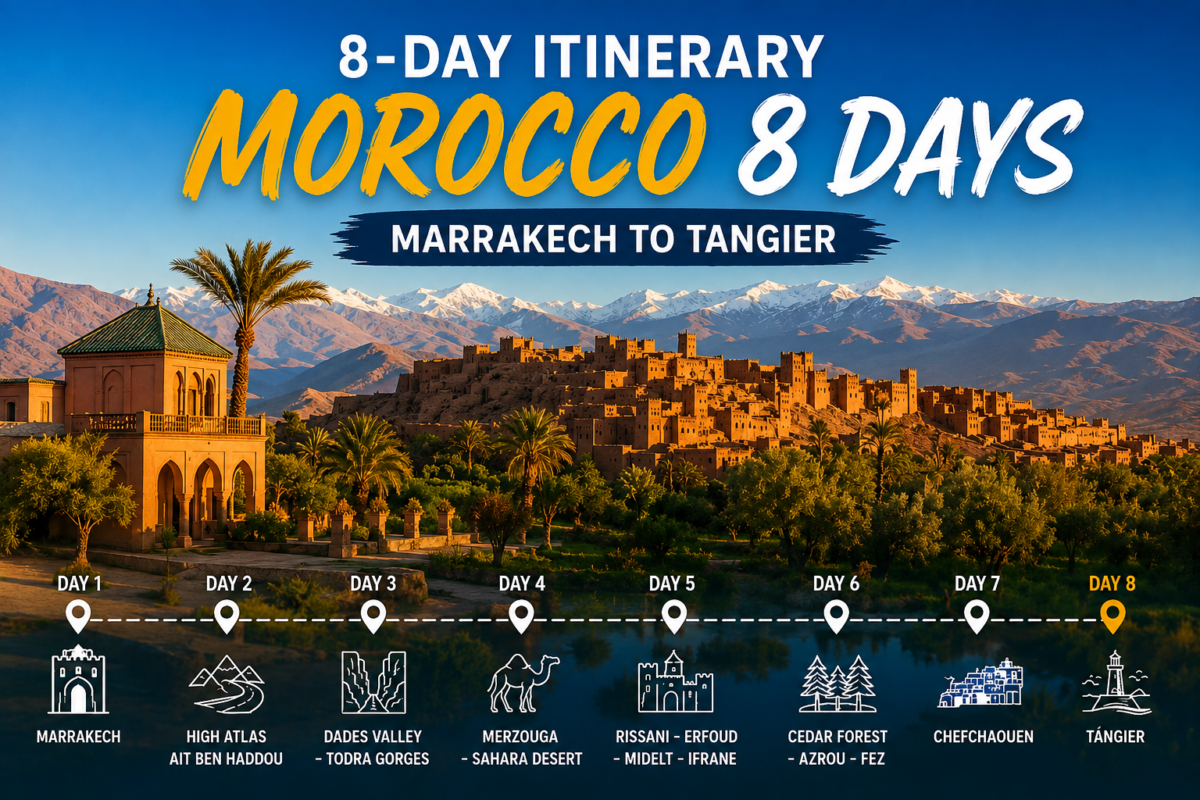
8-Day Morocco Itinerary: Marrakech to Tangier via the Sahara and Imperial Cities
An 8-day itinerary from Marrakech to Tangier lets you travel across Morocco from south to north without returning to your starting point. The route begins in Marrakech, crosses the High Atlas and the southern kasbahs, and reaches the Sahara. It then continues to Fes, Meknes, Volubilis and Chefchaouen. Finally, the journey ends in Tangier.
This is an ambitious route with several days spent on the road. Therefore, it is important to understand the pace before booking. The longest section is between Merzouga and Fes. Meanwhile, other days provide more time to explore the desert, medinas and historic sites.
This guide organizes the journey day by day. In addition, it explains what to see during each stage and where the main stops are usually made. It also covers what to consider when packing and compares alternative routes from Marrakech, Fes, Casablanca and Tangier.
Key Route Information
The complete journey combines mountain roads, major intercity routes and tracks around Merzouga. According to the itinerary described, the total distance is approximately 1,250 to 1,350 kilometers. Total driving time is roughly 22 to 25 hours across the eight days.
- Approximate distance: between 1,250 and 1,350 kilometers.
- Total driving time: approximately 22 to 25 hours.
- Recommended periods for this itinerary: March to May and September to November.
- Suggested transportation: a private vehicle with driver, using a 4×4 or minibus depending on the route and group.
- Longest stage: Merzouga to Fes, approximately 460 kilometers according to this itinerary.
The travel times are estimates. Traffic, roadworks, weather, stops and road conditions can affect each day’s schedule. Therefore, these figures are best used for planning rather than treated as guaranteed timings.
Day 1: Marrakech to Ouarzazate via Tizi N-Tichka and Ait Ben Haddou
The journey begins by leaving the plains of Marrakech and climbing into the High Atlas. The day’s final destination is Ouarzazate, one of the main gateways to routes through southern Morocco.
- Planned distance: 200 km.
- Estimated driving time: 4.5 hours.
- Notable elevation: approximately 2,260 meters at Tizi N-Tichka.
- Main road: N9.
Morning: High Atlas and Tizi N-Tichka Pass
Leaving Marrakech early gives you more time for the day’s stops. The N9 climbs through a landscape of valleys, mountain slopes and rural communities. Moreover, the winding road makes the journey itself an important part of the experience.
The Tizi N-Tichka pass reaches approximately 2,260 meters. Various points along the road provide views across the High Atlas. However, mountain weather can change quickly.
If you are prone to motion sickness on winding roads, prepare whatever you normally use to travel comfortably. It is also practical to keep a jacket within easy reach, especially when temperatures are lower.
Telouet Kasbah and Ounila Valley
After crossing the pass, the route can make a detour toward the Telouet Kasbah. This fortress is historically associated with the El Glaoui family. Inside, notable decorative elements include zellige tilework and carved wood.
From Telouet, the route continues through the Ounila Valley toward Ait Ben Haddou. This alternative road provides views of traditional architecture and rural scenery before reaching the famous ksar.
Afternoon: Ait Ben Haddou
Ait Ben Haddou is a collection of earthen buildings recognized as a UNESCO World Heritage Site. Its narrow streets climb between fortified dwellings toward the higher sections of the settlement.
In addition to its architectural importance, the site has been used as a filming location. Productions associated with the area include Gladiator and Lawrence of Arabia.
The original itinerary allows around 1.5 to 2 hours to explore the ksar. General access to the village is described as free. However, some family homes may charge a small amount to enter their interior spaces. Therefore, it is advisable to check current conditions when you visit.
If you are staying in Marrakech and want to explore this area without completing the full circuit, consider the Ouarzazate and Ait Ben Haddou Day Trip from Marrakech.
Arrival in Ouarzazate
After visiting Ait Ben Haddou, the route finishes in Ouarzazate. The day ends with an overnight stay in the city and, depending on the booked program, a traditional dinner.
Day 2: Ouarzazate to the Dades Valley via Skoura and the Valley of Roses
The second day moves at a more relaxed pace. The route crosses oases, palm groves and earthen architecture along the famous Road of a Thousand Kasbahs toward the Dades Valley.
- Planned distance: 140 km.
- Estimated driving time: 2.5 hours.
- Main areas: Skoura, Kalaat M’Gouna and Boumalne Dades.
- Main road: N10.
Morning: Ouarzazate, Skoura and Amridil Kasbah
The morning can begin with a visit to Taourirt Kasbah. Alternatively, you can explore the area’s film studios, depending on the available time and what your itinerary includes.
Afterwards, the journey continues toward the Skoura palm grove. This oasis combines palm trees, agricultural fields and traditional earthen buildings.
One of its best-known landmarks is Amridil Kasbah, whose origins date to the 17th century. A visit offers an opportunity to see earthen construction techniques and elements of traditional oasis life.
Afternoon: Valley of Roses and Dades
The route continues toward Kalaat M’Gouna and the Valley of Roses. The region is associated with the cultivation of Rosa damascena and products such as rose water and oils.
Later, the journey turns toward Boumalne Dades. Here, rock formations popularly known as the “Monkey Fingers” appear in the landscape. Finally, the day ends at an accommodation in the valley.
Day 3: Dades Valley to Merzouga and Erg Chebbi Desert Camp
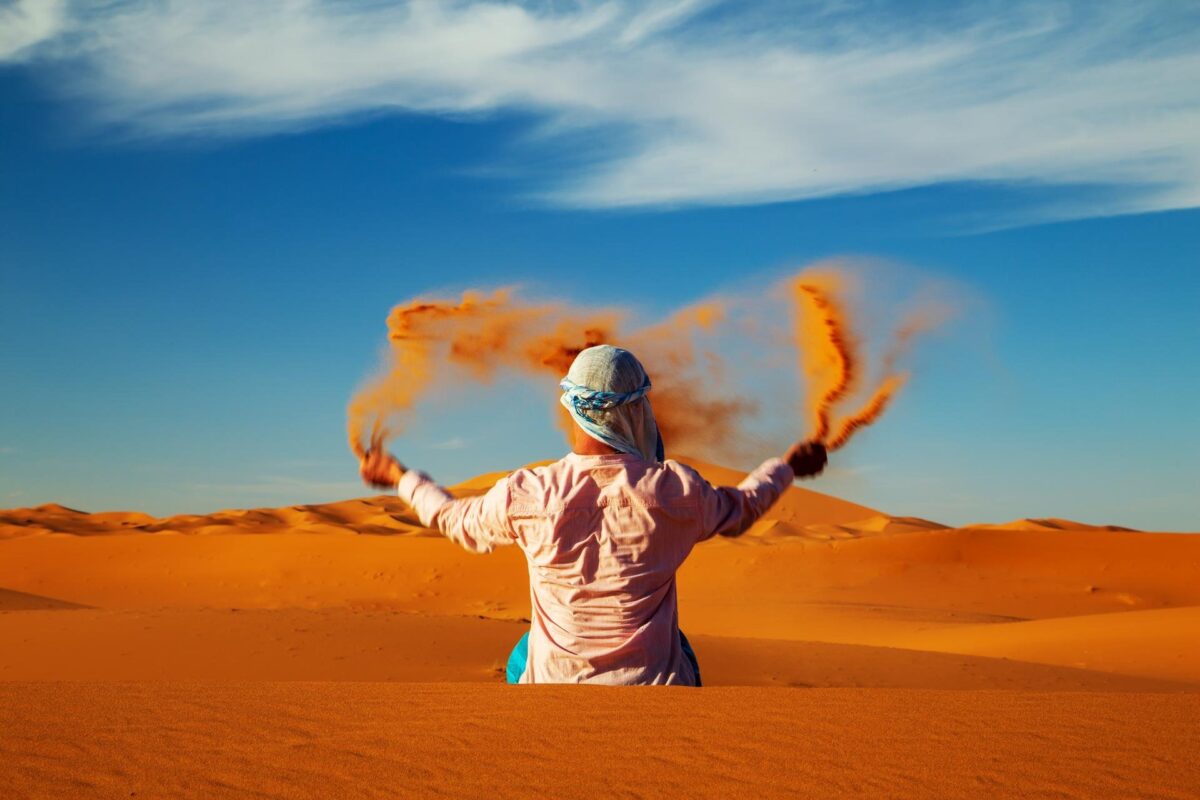
The third day marks your arrival in the Sahara. Before reaching Merzouga, the route passes through Todra Gorge and continues across the pre-desert regions toward Erg Chebbi.
- Planned distance: 270 km.
- Estimated driving time: 4 hours.
- Main experience: Erg Chebbi, camel ride and desert camp.
- Main route: N10 toward R702.
Morning: Todra Gorge
After leaving Dades, the route continues toward Tinghir and Todra Gorge. The canyon reaches approximately 300 meters in height at some points and can be explored on foot along its lower section.
The itinerary allows around 45 to 60 minutes to walk through the area. In mid-morning, sunlight may reach deeper into certain sections of the canyon. In addition, cafés and craft stalls can be found near the access area.
Afternoon: Erfoud and Arrival in Merzouga
After Todra, the route continues through Tinjdad toward Erfoud. The region is known for its marine fossils and workshops that use fossil-bearing stone.
Later, you reach Merzouga, located beside the dunes of Erg Chebbi. This same corridor forms part of the 3-Day Desert Tour from Marrakech to Fes via Merzouga and the 4-Day Desert Tour from Marrakech to Fes via Merzouga.
Sunset, Camel Ride and Sahara Desert Camp
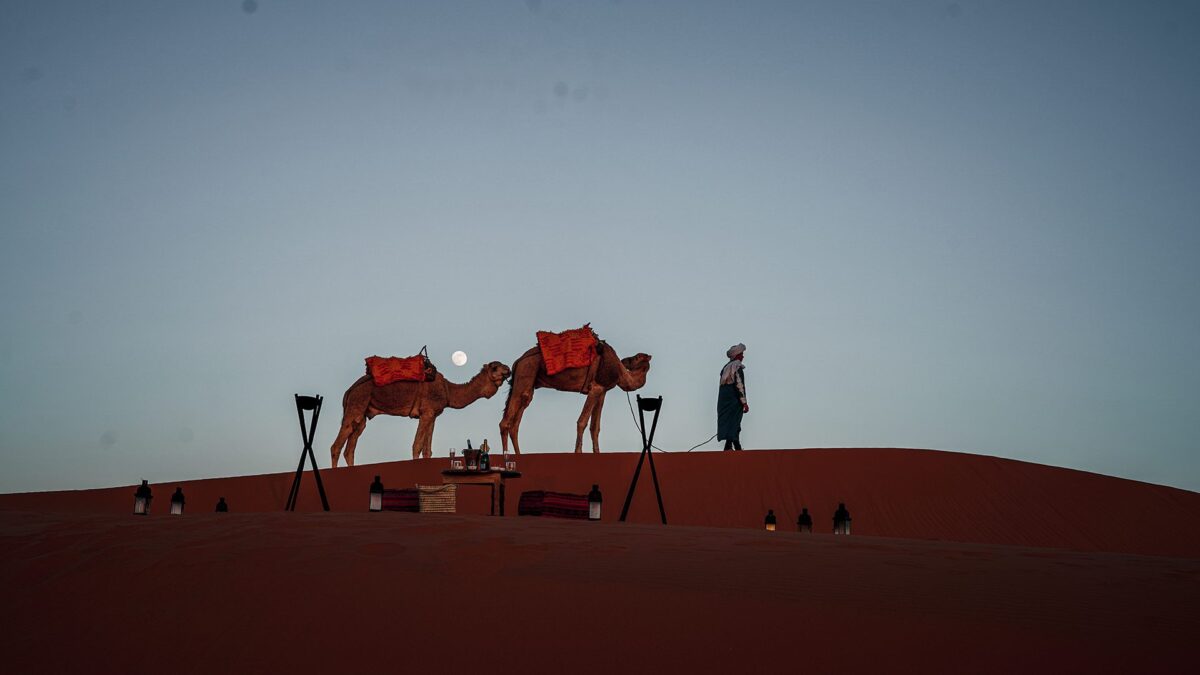
The itinerary includes an approximately one-hour camel ride to the camp. Therefore, the journey can coincide with sunset over the dunes. However, travelers who prefer not to ride a camel can ask whether a 4×4 transfer is available.
Desert camps are sold in different categories. Generally, standard options may provide simpler facilities and shared bathrooms. Higher-category camps may offer private bathrooms, electricity and more comfortable beds. Since services vary, check the details before booking.
The evening usually includes a Moroccan dinner. In addition, some programs offer traditional drumming around the fire.
Day 4: Merzouga, Sahara Culture, Khamlia and Oasis
After three days of point-to-point travel, day four focuses on the area around Merzouga. Consequently, you can discover cultural and scenic experiences that a single overnight stay might not allow time for.
- Estimated route: around 80 km.
- Approximate driving time: 2 hours by 4×4.
- Terrain: rocky tracks and desert areas.
- Transportation: 4×4 vehicle.
Sunrise and Semi-Nomadic Communities
Travelers who want to see the sunrise can wake before dawn. After breakfast, the circuit continues by 4×4 around Erg Chebbi.
Some programs include an organized encounter with semi-nomadic pastoral families. When participating in this type of visit, approach the experience respectfully and follow the guidance of your host or guide.
Another possible stop is the historic M’Fis mining area, which was associated with lead and kohl extraction during the 20th century.
Khamlia and Gnaoua Music
The village of Khamlia is known for its Gnaoua musical heritage and communities with sub-Saharan roots. A performance provides an introduction to the rhythms and musical traditions associated with this part of the Sahara.
Some performances may not have a fixed entrance fee, although making a contribution to the musicians can be customary. In any case, follow the guidance of your guide or host venue.
During the day, you may also have an opportunity to try medfouna, a traditional stuffed bread from the region. Depending on the preparation, it may contain meat, eggs and spices.
Merzouga Palm Grove and Dayet Srji
The afternoon can be spent exploring the Merzouga palm grove or the surroundings of Dayet Srji. The lake’s presence and appearance depend on natural conditions. Finally, the itinerary includes an overnight stay at a hotel in Merzouga.
Day 5: Merzouga to Fes via the Ziz Valley and Middle Atlas
Day five is the most demanding road stage in this itinerary. The journey leaves the Sahara and crosses the Ziz Valley. Afterwards, it continues toward Midelt, Azrou, Ifrane and Fes.
- Planned distance: 460 km.
- Estimated driving time: around 7.5 hours.
- Main stops: Ziz Valley, Midelt, Azrou and Ifrane.
- Main road: N13.
Ziz Valley and Midelt
The route leaves Merzouga, passes Rissani and continues toward the Ziz Valley. From its viewpoints, you can see an oasis contrasting with the arid slopes and reddish tones of the surrounding landscape.
Afterwards, the journey continues to Midelt, a mountain town known for apple production. Given the length of the day’s journey, this stop can also be used for lunch.
In the opposite direction, this corridor forms part of the 3-Day Desert Tour from Fes to Marrakech and the 4-Day Desert Tour from Fes to Marrakech.
Azrou, Barbary Macaques and Ifrane
Farther north, the road crosses cedar forests near Azrou. The area is home to wild Barbary macaques. If you see them, keep a sensible distance, protect your belongings and avoid giving them processed food.
Next, the route passes through Ifrane. Its architecture and sloping roofs explain its well-known nickname, the “Switzerland of Morocco.” Finally, the day ends with arrival in Fes and an overnight stay in a riad.
Day 6: Guided Tour of the Fes Medina
After the previous day’s long journey, day six is dedicated to Fes. Its historic medina, Fes el-Bali, forms part of the heritage recognized by UNESCO. Because of its complex network of streets, a local guide can provide historical context and make navigation easier.
Morning: Royal Palace, Mellah and Crafts
The tour can begin outside the medina before continuing on foot. Proposed stops include:
- Royal Palace: its exterior is notable for its large ornamental gates.
- Mellah: the historic Jewish quarter features architecture that differs from many parts of the medina.
- Borj Sud: the fortress offers panoramic views over Fes.
- Pottery workshop: an opportunity to observe traditional craft processes related to zellige.
Afternoon: Fes el-Bali
The route continues through Bab Bou Jeloud into the medina. Among its best-known landmarks are Al-Quaraouiyine, Al Attarine Madrasa and the Chouara Tanneries.
- Al-Quaraouiyine: a historic institution of learning and an important religious and cultural landmark in Fes.
- Al Attarine Madrasa: known for its decorative plasterwork, wood carving and zellige.
- Chouara Tanneries: several terraces offer views of the traditional leather-working and dyeing process.
Mint leaves are often offered on tannery terraces to help with the strong smell. After the visit, there may be time to explore the souks before returning to the riad.
Fes is also a strategic starting point for longer journeys. One option is the 7-Day Desert & Imperial Cities Loop Tour from Fes.
Day 7: Fes to Chefchaouen via Meknes and Volubilis
Day seven combines three different environments. First comes the imperial history of Meknes. Afterwards, the route visits the archaeological site of Volubilis and continues through the Rif Mountains toward Chefchaouen.
- Planned distance: 260 km.
- Estimated driving time: 4.5 hours.
- Main stops: Meknes and Volubilis.
- Route: N13 toward N2.
Meknes
The first major stop is Meknes, one of Morocco’s Imperial Cities. Its notable landmarks include Bab al-Mansour and the historic complex associated with Sahrij Souani.
Volubilis
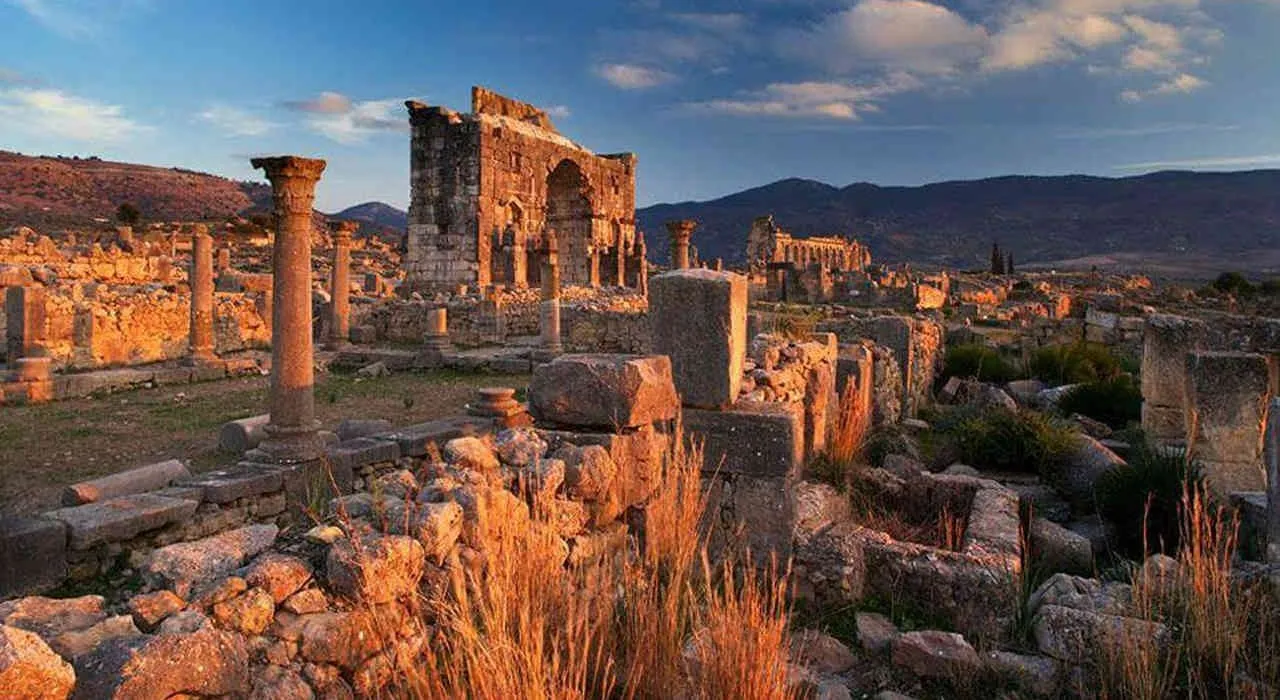
From Meknes, the journey continues toward Volubilis. The archaeological site preserves important Roman remains, including mosaics and monuments such as the triumphal arch.
You can explore the archaeological complex on foot. In addition, travelers who want more context can ask about the availability of a local guide.
Afternoon: Rif Mountains and Chefchaouen
After Volubilis, the journey heads north. The road crosses Rif landscapes, valleys and agricultural areas before reaching Chefchaouen.
The city lies among the mountains and is famous for the blue-painted façades of its medina. At the end of the day, you can walk through its streets and explore the area around Outa el-Hammam Square.
Day 8: Chefchaouen to Tangier
The final day provides time to spend part of the morning in Chefchaouen before traveling toward Tangier. According to this itinerary, the final stage covers approximately 115 kilometers and requires around two hours of driving.
Morning: Chefchaouen’s Blue Medina
Starting early allows you to explore the streets in a quieter atmosphere. Places included in this itinerary are:
- Outa el-Hammam Square: one of the main centers of medina life.
- Ras el-Maa: a waterside area beside the old town.
- Spanish Mosque: an elevated viewpoint known for views over Chefchaouen.
Afternoon: Arrival in Tangier
After Chefchaouen, the journey continues to Tangier. The city can serve as the final destination before continuing your journey by air or sea. Alternatively, you can extend your stay there.
The same connection with northern Morocco appears in reverse on a different itinerary, the 5-Day Desert Tour from Tangier to Marrakech via Merzouga.
Depending on your plans, the final transfer can take you to Tangier Airport, Tangier Ville Port or a hotel. If you have a flight or ferry on the same day, always confirm the schedule and allow sufficient time for possible delays.
What Is the Pace of This 8-Day Morocco Itinerary?
This route combines active days with more relaxed ones. Day three includes the journey to Merzouga and the desert camp experience. By contrast, day four focuses entirely on the surrounding desert area. Day five is clearly the longest road stage.
Therefore, this itinerary can work well for travelers who want to experience many different landscapes in eight days. However, those who prefer longer stays in each city should consider a longer itinerary.
Best Time to Take This Route
The original itinerary primarily recommends March to May and September to November. These periods can help avoid some of the seasonal extremes encountered across the Atlas, Sahara and northern Morocco.
Even so, conditions vary by altitude and region. For example, desert temperatures can drop significantly at night, while mountain passes experience different conditions. Therefore, it is advisable to check the weather forecast before departure.
Alternative Itineraries Based on Your Arrival City
Not every traveler needs to start in Marrakech. Routes are available from several of Morocco’s main gateways. Therefore, you can choose a circuit that fits your flights and onward travel plans more conveniently.
Alternatives from Marrakech
The selection of Tours from Marrakech includes itineraries of different lengths. If your main goal is to connect southern Morocco with Fes, consider the 5-Day Desert Tour from Marrakech to Fes via Merzouga.
If you prefer to stay in Marrakech and take shorter excursions, you can add an Essaouira Day Trip from Marrakech or an Ourika Valley Day Trip from Marrakech.
Alternatives from Fes
Tours from Fes allow you to begin directly in north-central Morocco. From there, you can travel toward Merzouga or choose routes that continue to Marrakech.
Alternatives from Casablanca
Travelers arriving in Casablanca can explore Tours from Casablanca. One option is the 5-Day Desert & Imperial Highlights Tour from Casablanca.
For travelers with more time, the 9-Day Grand Sahara & Imperial Cities Loop from Casablanca provides a longer alternative.
Alternatives from Tangier
Tours from Tangier are useful for travelers beginning their journey in northern Morocco. In addition, they make it possible to reverse the general direction of a route connecting the Rif, inland cities and the Sahara.
If you have additional time in the north, you can also explore destinations such as Tetouan. Alternatively, travelers planning a different circuit through Morocco’s capitals and historic cities can include Rabat.
Planning, Packing and Logistics
What to Pack
The route crosses coastal areas, mountains, inland valleys and desert landscapes. Therefore, clothing that can be worn in layers is the most practical choice.
- Layered clothing and a warm garment for cooler nights.
- Comfortable shoes for medinas, archaeological sites and uneven paths.
- Sun protection, including sunglasses, sunscreen and a hat.
- Anything you normally use to prevent motion sickness on winding roads.
- A plug adapter and portable battery if you need them for your devices.
- Modest clothing appropriate for traditional environments.
- A small backpack for the night at the desert camp.
Currency, Cash and Tipping
The local currency is the Moroccan dirham (MAD). The original itinerary uses an approximate exchange rate of around 10 MAD to 1 USD as a reference. However, exchange rates fluctuate, so check the current rate before traveling.
Cash can be particularly useful in rural areas, markets and small establishments. Therefore, it is practical to have money available before entering areas with fewer services.
The original guide provides the following tipping references. They are suggestions rather than requirements and can be adjusted according to the service received:
- Private driver: between 200 and 300 MAD per day per group.
- Local guides: between 150 and 200 MAD per half-day.
- Camel handlers and camp staff: between 100 and 150 MAD in total.
- Restaurants: around 10% in cash as a reference.
How to Manage Long Driving Days
Comfort during the journey depends on both the vehicle and the pace. Therefore, it is worth leaving enough time for rest stops, meals and scenic viewpoints. This is particularly important in the High Atlas and during the Merzouga-to-Fes stage.
It is also advisable to confirm what your transportation includes in advance. Check the vehicle type, luggage allowance, air conditioning, pickup arrangements and final drop-off points.
Frequently Asked Questions About an 8-Day Morocco Itinerary
Are 8 days enough to travel from Marrakech to Tangier via the Sahara?
Yes. The itinerary described connects Marrakech and Tangier in eight days via Erg Chebbi, Fes, Meknes, Volubilis and Chefchaouen. However, the pace is active, and the Merzouga-to-Fes section requires a long day on the road.
Is this itinerary suitable for families with children?
It can work for families, although the length of the transfers should be considered carefully. Day five includes approximately 7.5 hours of estimated driving. Private transportation also makes it easier to stop when necessary.
Is it better to finish the tour in Tangier than return to Marrakech?
Finishing in Tangier avoids retracing the route south. In addition, it allows you to continue from northern Morocco by air, ferry or with an extended stay. The better option depends on your onward travel plans.
Do I need a 4×4 for the entire journey?
The itinerary recommends private transportation and uses a 4×4 for certain routes around Merzouga. However, the exact vehicle requirements depend on the booked itinerary and group size.
Can I reach the desert camp without riding a camel?
Yes. Some programs allow travelers to reach the camp by 4×4. If you prefer this alternative, confirm it before booking because arrangements vary by operator and camp.
Is it advisable to rent a car for this route?
The route uses several major roads but also includes mountain passes and desert sections. Travelers who prefer not to drive can choose a vehicle with a driver. If you plan to drive yourself, check the route and rental conditions beforehand.
Does it get cold in the Sahara at night?
Temperatures can fall quickly after sunset. The original guide states that winter temperatures can approach 0°C. Therefore, warm clothing is advisable even when daytime conditions have been mild.
What type of accommodation does the itinerary include?
The itinerary combines accommodation in Ouarzazate, Dades, Merzouga, Fes and Chefchaouen with one night at an Erg Chebbi desert camp. The exact category and services depend on the option booked.
Conclusion: Is an 8-Day Marrakech to Tangier Morocco Itinerary Worth It?
This 8-day itinerary is a comprehensive option for travelers who want to cross Morocco without returning to their starting point. It combines the High Atlas, southern kasbahs, Erg Chebbi, the Middle Atlas, Fes, Meknes, Volubilis and Chefchaouen before ending in Tangier.
Its main advantage is variety. However, that diversity also means an active pace and several days of driving. Therefore, consider how much time you want to spend traveling compared with the time available at each destination.
If eight days fit your schedule, a linear route can help you make better use of your journey. However, if you prefer a slower experience, consider choosing a longer itinerary or reducing the number of stops.