
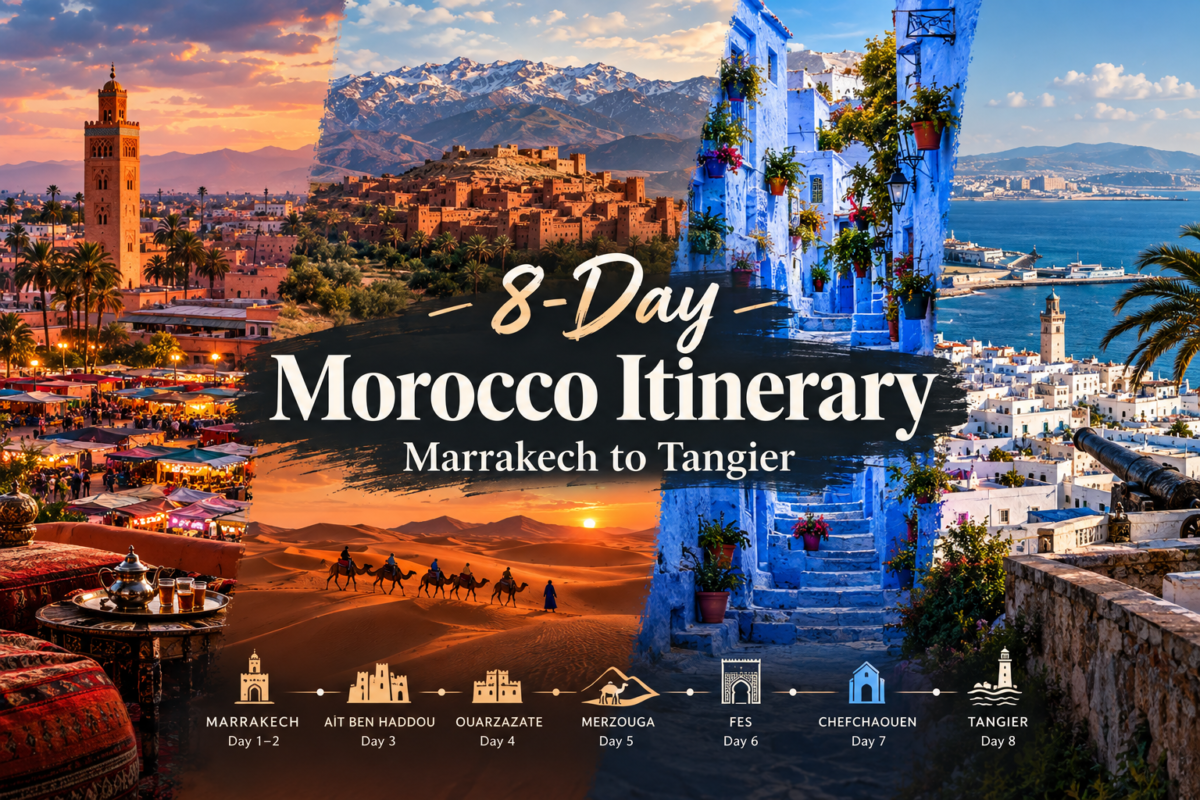
This 8-day Morocco itinerary travels one way from Marrakech to Tangier. Along the way, it crosses the High Atlas Mountains, the kasbahs of southern Morocco, the Erg Chebbi dunes, Fes, Volubilis, Meknes, and Chefchaouen. It’s an ambitious but rewarding route, one that suits travelers who want Morocco’s mountains, desert, historic cities, and northern Rif region without returning to their starting point.
In total, the complete journey covers roughly 1,250 to 1,350 kilometers, depending on local detours and desert excursions. Expect approximately 22 to 25 hours of driving across the eight days. Most days balance road time with sightseeing. The Merzouga-to-Fes journey on Day 5, though, is considerably longer than the rest.
This guide breaks down the route day by day: approximate distances, driving times, worthwhile stops, practical considerations, and realistic pacing. Treat driving times as estimates, since weather, mountain-road conditions, traffic, construction, and sightseeing stops can all affect the schedule. You can book this exact route, with private transport and accommodation included, as our 8-Day Essential Morocco Tour from Marrakech to Tangier.
8-Day Marrakech to Tangier Route at a Glance
- Day 1: Marrakech to Ouarzazate via Tizi N’Tichka, Telouet, and Ait Ben Haddou — approximately 200 km and 4.5 hours of net driving.
- Day 2: Ouarzazate to Dades Valley via Skoura and the Rose Valley — approximately 140 km and 2.5 hours of net driving.
- Day 3: Dades Valley to Merzouga via Todra Gorge and Erfoud. Approximately 270 km and 4 hours of net driving, followed by a camel trek or 4×4 transfer to camp.
- Day 4: Merzouga desert circuit — approximately 80 km of regional driving and off-road exploration.
- Day 5: Merzouga to Fes via the Ziz Valley, Midelt, Azrou, and Ifrane — approximately 460 km and 7.5 hours of net driving.
- Day 6: Full day exploring Fes, including Fes el-Bali, the tanneries, madrasas, craft districts, and viewpoints.
- Day 7: Fes to Chefchaouen via Meknes and Volubilis — approximately 260 km and 4.5 hours of net driving.
- Day 8: Chefchaouen to Tangier — approximately 115 km and around 2 hours of net driving, depending on traffic and your destination in Tangier.
Route Overview and Essential Travel Planning
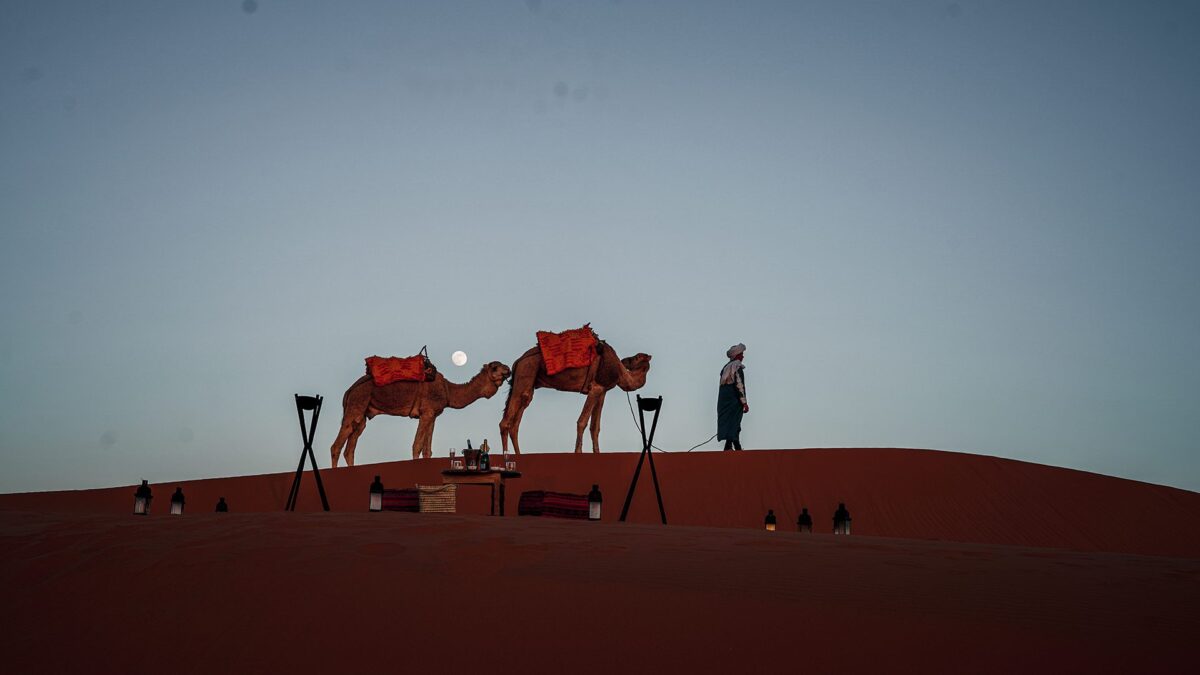
In short, a linear Marrakech-to-Tangier itinerary avoids unnecessary backtracking. In eight days, the route takes you from the plains around Marrakech over the High Atlas. From there, it follows the old kasbah corridor into the Sahara at Erg Chebbi. From there it continues north to medieval Fes, through the Rif Mountains, and finishes on Morocco’s northern coast.
How much driving does this itinerary involve?
The route totals approximately 1,250 to 1,350 kilometers when local excursions are included, with around 22 to 25 hours behind the wheel over eight days. Those figures represent net driving rather than total daily travel time. Meals, viewpoints, guided visits, roadworks, fuel stops, and photography can add several hours to individual days.
A private air-conditioned vehicle with an experienced driver is a convenient option, since the itinerary includes winding mountain roads and a regional desert circuit. Self-driving is possible on the main paved roads. Off-road desert excursions, however, should only be attempted with a suitable vehicle, local knowledge, and appropriate conditions.
Best time for a Marrakech-to-Tangier road trip
Spring, from March to May, and autumn, from September to November, generally provide the most comfortable balance of temperatures. Summer can be extremely hot around Merzouga. Winter, on the other hand, brings cold desert nights and the possibility of difficult weather at higher elevations in the Atlas Mountains.
Conditions at Tizi N’Tichka can change quickly. Travelers visiting in winter should check the forecast and road situation shortly before departure, rather than assuming the pass will operate normally.
Day 1: Marrakech to Ouarzazate via Tizi N’Tichka and Ait Ben Haddou
Leave Marrakech early for the journey across the High Atlas Mountains to Ouarzazate, often described as a gateway between the Atlas and Morocco’s pre-Saharan landscapes. The day combines mountain scenery, historic earthen architecture, and one of the country’s best-known fortified villages.
- Approximate distance: 200 km, depending on the route and detours
- Net driving time: Around 4.5 hours
- Highest point: Tizi N’Tichka Pass, approximately 2,260 meters
- Main road: N9, with a detour through the Ounila Valley when conditions allow
Morning: High Atlas Mountains and Tizi N’Tichka
The N9 climbs from the Marrakech plain into increasingly rugged mountain terrain, passing terraced slopes, villages, roadside viewpoints, and dramatic geological formations. At approximately 2,260 meters, Tizi N’Tichka is the highest point of the day’s journey and a useful place for a short scenic stop.
The road contains frequent bends and elevation changes, so travelers prone to motion sickness may want to prepare before departure. Keep a jacket or warm layer accessible, too, as temperatures at the pass can be substantially cooler than in Marrakech.
After crossing the pass, consider the detour to Telouet Kasbah. The former residence associated with the powerful Glaoui family has an austere earthen exterior. Inside, though, it holds elaborate decorative work, including zellige, carved plaster, and cedar elements. Access conditions and restoration work can change, so check locally before planning a detailed visit.
Afternoon: Ounila Valley and Ait Ben Haddou
From there, continue through the Ounila Valley toward Ait Ben Haddou, a fortified earthen settlement and UNESCO World Heritage Site. The ksar illustrates traditional pre-Saharan architecture and occupies a striking hillside position beside the Ounila River.
Travelers with less time in Morocco often visit the same area on an Ouarzazate and Ait Ben Haddou Day Trip from Marrakech. The settlement has also appeared in numerous film and television productions, adding to its international profile.
Allow approximately 1.5 to 2 hours if you want to cross into the village, explore its lanes, and climb toward the upper viewpoints. Access to the public village itself has traditionally not required a general admission ticket. Individual privately maintained buildings, though, may charge a small entrance fee, commonly around 10 to 20 MAD. Local arrangements can change.
From Ait Ben Haddou, continue to Ouarzazate for dinner and an overnight stay.
Day 2: Ouarzazate to Dades Valley via Skoura and Rose Valley
Day 2 follows part of southern Morocco’s famous kasbah corridor. Compared with the previous day, the driving is relatively light. That leaves time for historic architecture, palm groves, the Rose Valley, and the rock formations of the Dades Valley.
- Approximate distance: 140 km
- Net driving time: Around 2.5 hours
- Main areas: Ouarzazate, Skoura, Kalaat M’Gouna, and Boumalne Dades
- Main road: N10
Morning: Ouarzazate, Skoura, and Kasbah Amridil
Before leaving Ouarzazate, you can visit Taourirt Kasbah or, if it fits your interests and schedule, explore one of the area’s film studios. Ouarzazate and its surroundings have long been used as locations for international film productions.
Afterward, continue east to the Skoura palm grove, an extensive oasis landscape dotted with date palms and traditional earthen buildings. One of its best-known landmarks is Kasbah Amridil, a 17th-century fortified residence that offers a useful introduction to southern Moroccan architecture and traditional agricultural life.
Inside the complex, visitors can see features associated with food storage, olive-oil production, domestic life, and construction adapted to a hot, dry climate.
Afternoon: Rose Valley and Dades Gorge
From there, the route continues toward Kalaat M’Gouna and the Rose Valley, known for the cultivation of fragrant roses used for rose water, oils, and cosmetic products. The harvest takes place in spring, so travelers at other times of year should not expect fields filled with flowers. Local cooperatives and shops, however, sell rose-derived products throughout the year.
At Boumalne Dades, turn toward the Dades Valley. As you travel farther into the gorge, the landscape becomes increasingly dramatic, with sculpted cliffs and distinctive formations known as the Monkey Fingers, or Les Doigts de Singe.
Spend the night at a riad or hotel in the Dades area. If daylight allows, late afternoon is an excellent time to enjoy the valley viewpoints before dinner.
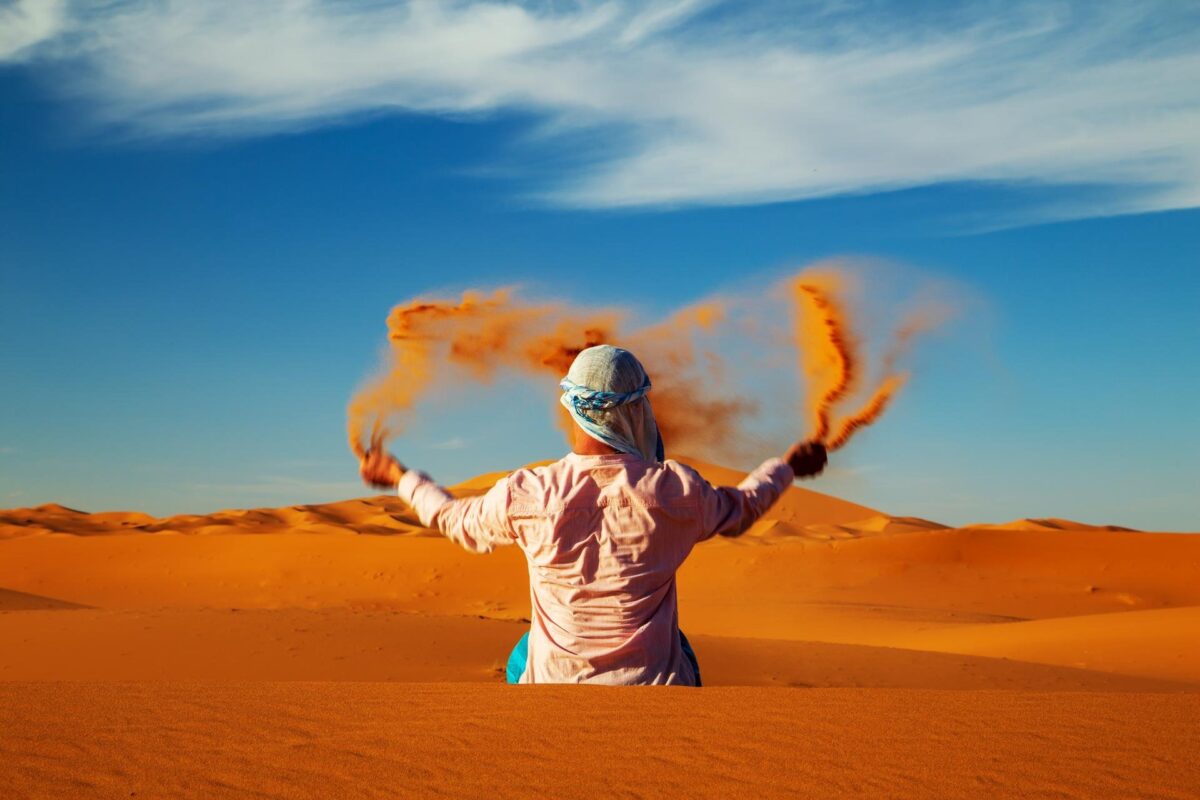
A sunset view across the rugged landscapes of southern Morocco.
Day 3: Dades Valley to Merzouga and Erg Chebbi Desert Camp
Day 3 leaves the mountain valleys behind and continues toward the Sahara. The highlights are Todra Gorge, the increasingly arid landscapes around Erfoud, and an evening among the Erg Chebbi dunes near Merzouga.
- Approximate distance: 270 km
- Net driving time: Around 4 hours
- Main highlight: Erg Chebbi sunset and desert camp
- Main roads: N10 and regional roads toward Merzouga
Morning: Todra Gorge
Leave the Dades Valley after breakfast, stopping at one of the road viewpoints if conditions and traffic allow. Continue toward Tinghir and then north into Todra Gorge, where steep limestone walls rise above the river corridor.
A 45- to 60-minute walk is enough for most visitors to experience the narrowest and most impressive section. The terrain near the principal visitor area is relatively accessible, and roadside cafes and stalls are usually available. Mid-morning light can work well for photography, as sunlight begins to reach deeper into the canyon.
Afternoon: Erfoud to the Erg Chebbi dunes
Next, return toward Tinghir and continue through Tinjdad and Touroug. Around Erfoud, the environment becomes markedly drier. The area is known for fossil-rich limestone, and local workshops produce polished objects from stone containing ancient marine fossils.
By late afternoon, arrive near Merzouga at the edge of Erg Chebbi. Travelers planning a shorter south-to-north journey can cover many of the same highlights on a 3-Day Desert Tour from Marrakech to Fes via Merzouga. A 4-Day Desert Tour from Marrakech to Fes via Merzouga provides additional time for the route.
Evening: Camel trek and Sahara camp
At the dune edge, pack the belongings you need overnight into a small bag while your main luggage is transferred according to your camp’s arrangements. Many camps offer a camel trek of around an hour, although timing and distance depend on the camp location. A 4×4 transfer is generally available for travelers who prefer not to ride a camel.
Sunset is the main event. Dune colors shift as the light changes, followed by an evening meal at camp. Many camps also arrange local music around a communal fire when weather permits.
Accommodation standards vary considerably. Basic camps may have simple tents and shared facilities, while higher-end camps can offer beds, private bathrooms, hot showers, electricity, and charging points. Confirm the facilities of your specific camp rather than relying on the word “luxury,” which is used broadly in Merzouga.
Day 4: Merzouga Desert Circuit, Nomadic Heritage and Khamlia
Instead of leaving Erg Chebbi immediately, dedicate a second day to the wider Merzouga region. This slower pace gives a better sense of the area’s rocky hammada landscapes, communities, music, oasis agriculture, and seasonal wetlands.
- Approximate regional distance: 80 km
- Driving time: Around 2 hours, excluding stops
- Terrain: Paved roads, gravel pistes, hammada, and potentially sandy tracks
- Recommended transport: Suitable 4×4 with an experienced local driver
Morning: Sunrise and the desert surroundings
Rise early if you want to watch sunrise over the dunes, then have breakfast before beginning the regional circuit. Routes vary according to weather and track conditions, but excursions commonly cross the rocky terrain outside Merzouga and may include an arranged visit with a semi-nomadic family.
Approach such visits as cultural exchanges rather than tourist performances. Follow your host’s lead, ask permission before photographing people, and buy or tip only when it feels appropriate to the encounter.
Another possible stop is M’Fis, an area associated with former mineral extraction. Its surrounding rocky plains contrast sharply with the nearby dunes and offer broad views across the desert landscape.
Afternoon: Khamlia, Gnaoua music, and Dayet Srji
After that, continue to Khamlia, a village closely associated with Gnaoua musical traditions. Performances typically feature the gimbri, metal qraqeb castanets, vocals, and complex rhythmic patterns. If attending a performance, a contribution or tip is a considerate way to support the musicians.
Lunch can be taken in Khamlia or Merzouga. One regional dish to look for is medfouna, a stuffed flatbread prepared with a savory filling whose ingredients vary by cook and household.
Later, explore the palm groves near Merzouga or visit Dayet Srji. This seasonal lake depends heavily on rainfall and may be dry; when water is present, though, it can attract migratory birdlife, including flamingos. Spend the second night at a desert-edge hotel or riad, giving yourself time to rest before the long drive north.
Day 5: Merzouga to Fes via Ziz Valley, Midelt, Azrou and Ifrane
This is the longest transit day of the itinerary. The drive connects the Sahara with Fes via the Ziz Valley and Middle Atlas, with dramatic changes in altitude, temperature, and vegetation along the way.
- Approximate distance: 460 km
- Net driving time: Around 7.5 hours
- Main stops: Ziz Valley, Midelt, Azrou cedar country, and Ifrane
- Typical road: N13 and connecting roads
Morning: Rissani and the Ziz Valley
To start, depart Merzouga early, passing through Rissani before following the Ziz corridor toward Errachidia. Date palms form long green ribbons along the valley floor between otherwise arid slopes. Stop at a safe panoramic viewpoint for photographs before continuing north.
Travelers taking the route in the opposite direction will encounter much of the same scenery. They can do it on a 3-Day Desert Tour from Fes to Marrakech, or on the more leisurely 4-Day Desert Tour from Fes to Marrakech.
Continue into the high plains and stop around Midelt for lunch. The town lies between the Middle and High Atlas ranges and is particularly associated with apple-growing and the surrounding mineral-rich region.
Afternoon: Middle Atlas and Barbary macaques
After Midelt, landscapes become greener as the road reaches the Middle Atlas. Cedar woodland around Azrou and Ifrane provides habitat for Barbary macaques, an endangered macaque species native to North Africa, with a separate introduced population on Gibraltar.
Don’t feed wild macaques. Maintain distance, secure loose belongings, and avoid encouraging close interaction for photographs — feeding changes wild behavior and can expose animals to unsuitable foods.
Continue through Ifrane, known for its cool climate, landscaped public spaces, and pitched-roof architecture, before descending toward the Saïss Plain and Fes. Check into a riad in or near the medina for two nights.
Day 6: Full-Day Fes Medina Tour
Fes is one of Morocco’s four historic imperial cities. Fes el-Bali, the old medina, forms part of the UNESCO-listed Medina of Fez. It contains a dense network of lanes, workshops, markets, religious buildings, fountains, and traditional houses. Much of its historic core is pedestrianized, so walking is the best way to explore it.
A knowledgeable licensed local guide can be especially useful here, both for navigation and for understanding the city’s architecture, craftsmanship, religious history, and urban development.
Morning: Royal Palace, Mellah, viewpoints, and ceramics
- Royal Palace gates: Stop outside Dar al-Makhzen to see its elaborate monumental doors. The palace interior is not generally open for tourist visits.
- Fes Mellah: Walk through the historic Jewish quarter and notice architectural features such as street-facing wooden balconies.
- Panoramic viewpoint: Visit one of the elevated fortifications around the city, such as Borj Sud when accessible, for a view across the medina.
- Pottery and zellige workshop: See how ceramics and geometric zellige pieces are formed, cut, glazed, and assembled by local craftspeople.
Afternoon: Fes el-Bali on foot
Enter the old city through or near Bab Bou Jeloud and continue into the network of souks and historic streets. Major points of interest include Al-Qarawiyyin, founded in the 9th century and famous for its long history of scholarship. Access to active religious spaces can be restricted for non-Muslim visitors, although architectural details can often be viewed from permitted entrances.
Al Attarine Madrasa is another highlight, particularly for its Marinid-era zellige, carved cedar, and plaster decoration. Access and opening arrangements can change, so verify locally on the day of your visit.
Continue to the Chouara Tanneries, where hides are processed and dyed in a distinctive landscape of stone vats. The elevated terraces of neighboring leather shops provide the familiar view over the tannery. Mint sprigs are sometimes offered because smells from the leather-working process can be strong, especially in warm weather.
Finish the afternoon around Place Seffarine, the spice markets, textile areas, and craft workshops before returning to your riad. Travelers beginning their trip in the city can compare additional Tours From Fes, including a 7-Day Desert & Imperial Cities Loop Tour from Fes.
Day 7: Fes to Chefchaouen via Meknes and Volubilis
Day 7 links imperial Moroccan history with Roman archaeology before finishing in the Rif Mountains. The route includes Meknes, Volubilis, and Chefchaouen, making it one of the itinerary’s most historically varied days.
- Approximate distance: 260 km
- Net driving time: Around 4.5 hours
- Main stops: Meknes and Volubilis
- Final destination: Chefchaouen
Morning: Imperial Meknes
In the morning, drive west from Fes toward Meknes, which became an imperial capital under Sultan Moulay Ismail in the 17th century. Bab Mansour is the city’s best-known monumental gateway and provides a memorable introduction to the scale of the imperial complex.
Depending on current access and restoration work, other possible stops include Sahrij Souani and structures associated with the royal granaries and stables. Because conservation projects can temporarily alter access to historic sites, confirm availability locally.
Volubilis Roman archaeological site
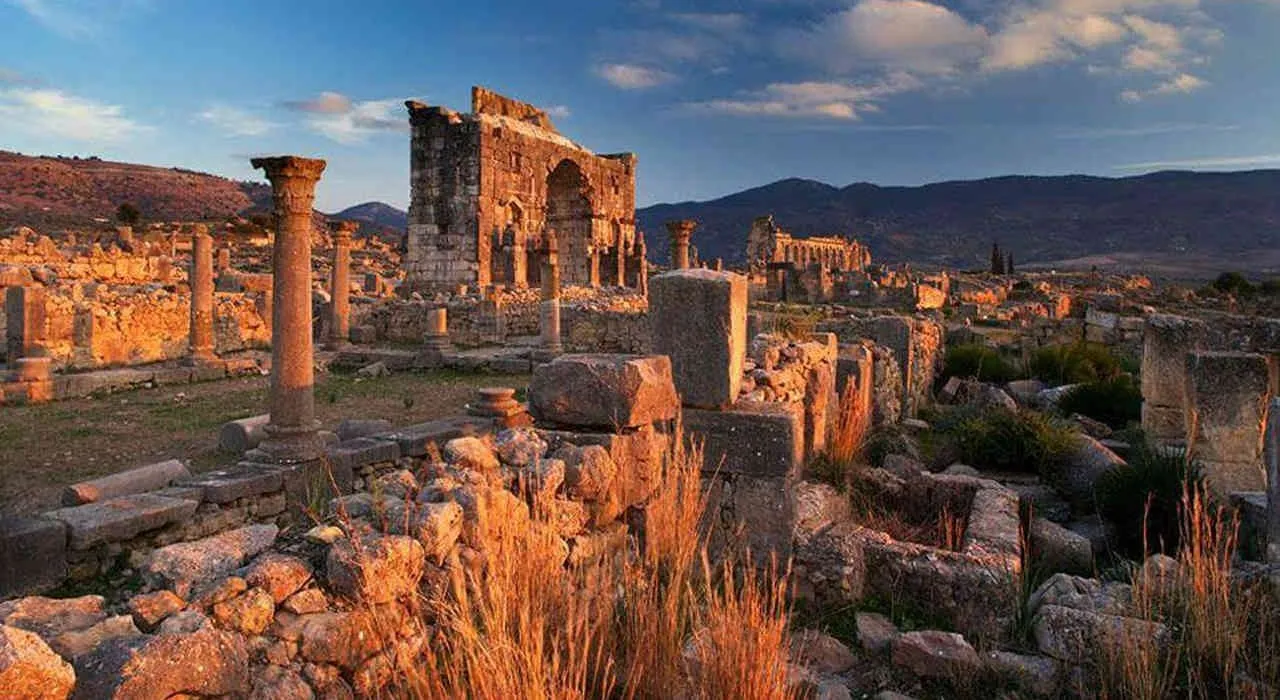
Afterward, continue toward Volubilis, the UNESCO-listed archaeological remains of an important Roman city in the province of Mauretania Tingitana. The site flourished particularly during the 2nd and 3rd centuries and preserves streets, monumental buildings, olive presses, and remarkable floor mosaics.
Allow around 1 to 1.5 hours for a useful first visit. Highlights include the triumphal arch, basilica and capitol area, Decumanus Maximus, and mosaics depicting subjects such as Hercules and Bacchus. A private site guide has traditionally cost approximately 200 to 300 MAD for an hour, although fees can change and should be confirmed at the site.
Afternoon: Rif Mountains and Chefchaouen
After lunch in the wider Volubilis and Moulay Idriss Zerhoun area, continue north through increasingly mountainous countryside toward Chefchaouen. The approach passes olive groves, valleys, farmland, and Rif Mountain scenery.
Chefchaouen sits below distinctive mountain peaks, and its name is commonly associated with their horn-like form. Arrive in the late afternoon, check into your riad, and use the softer evening light for an introductory walk around the blue-painted medina and Outa el-Hammam Square.
Day 8: Chefchaouen to Tangier
The final day combines a quiet morning in Chefchaouen with the transfer north to Tangier. If you have an afternoon flight or ferry, plan your departure conservatively and leave extra time for traffic, check-in, and unexpected road delays.
- Approximate distance: 115 km
- Net driving time: Around 2 hours in normal conditions
- Possible drop-offs: Tangier Ibn Battouta Airport, Tangier Ville Port, or a city hotel
Morning: Exploring Chefchaouen’s Blue Medina
Chefchaouen is celebrated for blue-painted facades, stairways, doors, and lanes throughout its medina. Several explanations are repeated for the blue color, including religious symbolism, practical ideas about insects or heat, and the city’s more recent tourism identity. No single explanation fully accounts for when and why all of Chefchaouen became blue.
Start before the busier day-trip period for quieter streets and easier photography. Worthwhile places include Outa el-Hammam, the central square beside the kasbah and Grand Mosque, and Ras el-Maa, where water emerges at the eastern edge of the medina. Also worth it: the uphill path toward the Spanish Mosque viewpoint.
The Spanish Mosque walk involves a climb and can take longer than 15 minutes, depending on your starting point and fitness. The reward is a broad view over the medina and surrounding Rif Mountains.
Afternoon: Transfer to Tangier
To begin, meet your driver at an agreed point accessible by vehicle and continue north toward Tangier. The same northern corridor is used in reverse by travelers joining a 5-Day Desert Tour from Tangier to Marrakech via Merzouga.
Depending on your onward plans, finish at Tangier Ibn Battouta Airport, Tangier Ville passenger port, or a Tangier hotel. If flying on Day 8, a departure in the later afternoon provides a more comfortable margin than an early flight.
For ferry passengers, check the exact departure port printed on the booking. Tangier Ville serves routes including the fast connection with Tarifa, while services to Algeciras commonly use Tanger Med, which is outside central Tangier. Ferry routes and schedules can change, so confirm them directly with the operator.
If you’re staying overnight, Tangier offers enough to justify additional time, including its kasbah, medina, American Legation, seafront, and excursions toward Cape Spartel.
Alternative Morocco Itineraries and Starting Points
In general, eight days works well for travelers who specifically want a one-way Marrakech-to-Tangier journey. If your flights, available time, or priorities differ, another starting point may produce a more efficient route.
- Marrakech: Browse Tours From Marrakech for shorter and longer desert routes. A 5-Day Desert Tour from Marrakech to Fes via Merzouga provides more time than the shortest Sahara crossings. Travelers remaining near Marrakech can instead consider a day trip. Good options are an Essaouira Day Trip from Marrakech, an Ourika Valley Day Trip from Marrakech, or an Ouzoud Waterfalls day trip.
- Fes: Desert routes from Fes are particularly convenient for travelers who want to cross the Middle Atlas before reaching Merzouga.
- Casablanca: Travelers arriving through Casablanca can explore Tours From Casablanca. Shorter options include a 5-Day Desert & Imperial Highlights Tour from Casablanca. For travelers with more time, the 9-Day Grand Sahara & Imperial Cities Loop from Casablanca fits better.
- Tangier: Tours From Tangier work particularly well for visitors arriving in northern Morocco by air or ferry and traveling south through Chefchaouen, Fes, and eventually the Sahara.
Practical Planning for This 8-Day Morocco Itinerary
What to pack
Overall, this route crosses several climatic zones, so layers are more useful than a wardrobe built solely for desert heat. Temperatures can differ significantly between Marrakech, the High Atlas, Erg Chebbi, the Middle Atlas, and northern Morocco.
- Light, breathable daytime clothing plus a fleece, sweater, or jacket for mountains and desert evenings.
- Comfortable walking shoes with reliable grip for medinas, archaeological sites, and uneven paths.
- Sunscreen, sunglasses, a hat, and a reusable water bottle.
- Personal medication, motion-sickness remedies if required, and basic travel first-aid supplies.
- Type C or E-compatible charging equipment and a power bank for longer road days.
- A light scarf or extra layer for sun protection and visits to conservative areas.
- A compact overnight bag for the desert camp, so you don’t need to carry your full luggage into the dunes.
Cash, cards, and Moroccan dirhams
To begin with, the Moroccan dirham (MAD) is the local currency. Cards are increasingly accepted by hotels, restaurants, and businesses in major cities. Cash, though, remains useful for small shops, cafes, tips, rural stops, local guides, and purchases in the medina.
The original rule of thumb of roughly 10 MAD to one US dollar can be useful for quick mental arithmetic, but exchange rates fluctuate. Check the current rate before traveling rather than budgeting around a fixed conversion.
ATMs are readily available in major cities such as Marrakech and Fes, and in many regional towns. Carry enough cash for rural stretches without keeping all of your money in one place.
Tipping in Morocco
Tipping is customary in many tourism settings, but there’s no single mandatory amount for every driver, guide, camp employee, or restaurant. The appropriate tip depends on service level, group size, tour length, and what’s already included in your booking. Around 10% is a common reference point for good restaurant service when a service charge hasn’t already been included. For drivers, guides, camel handlers, and camp staff, ask your tour operator for current guidance and tip according to the service received.
Private driver or self-drive?
In short, both are possible. A private driver reduces the workload on a fast itinerary and lets everyone in the group enjoy the scenery. It’s also useful for managing hotel access, viewpoints, regional stops, and the long Merzouga-to-Fes day.
Self-driving offers more independence. Travelers, though, need to be comfortable with mountain roads, changing speed limits, police checkpoints, urban traffic, pedestrians and animals near rural roads, and occasional roadworks. Avoid driving unfamiliar rural and mountain roads after dark whenever possible. A standard rental vehicle should not go onto unsuitable desert tracks unless the rental agreement explicitly permits it.
Frequently Asked Questions
Is eight days enough to travel from Marrakech to Tangier via Merzouga?
Yes, but this is an active itinerary rather than a slow trip. Eight days lets you see the High Atlas, Ait Ben Haddou, Dades and Todra, Erg Chebbi, Fes, Volubilis, Meknes, and Chefchaouen while traveling one way to Tangier. Travelers who dislike long drives would benefit from adding one or two extra days.
Which day involves the most driving?
Day 5, from Merzouga to Fes, is the longest, at approximately 460 kilometers and around 7.5 hours of net driving. With lunch, viewpoints, and rest stops, it occupies most of the day.
Is this Morocco itinerary suitable for families with children?
It can work well for families, particularly with private transport that allows flexible rest and bathroom stops. The main consideration is the long Day 5 drive. Families should also confirm child-seat availability before booking, since standards and availability can vary between transport providers.
Can I self-drive from Marrakech to Merzouga and Tangier?
Yes. The main intercity portions of the route use established paved roads. Mountain driving, however, requires concentration, and off-road desert circuits require different skills and an appropriate vehicle. Travelers who self-drive can arrange a local 4×4 excursion after reaching Merzouga rather than taking a rental car onto desert pistes.
How cold does the Sahara get at night?
Desert temperatures fall quickly after sunset. From November through February, nighttime temperatures around Erg Chebbi can approach approximately 0°C to 5°C (32°F to 41°F), although conditions vary. Warm layers matter even when your camp supplies thick blankets, so confirm whether your accommodation actually provides heating.
Is a camel trek required to stay at an Erg Chebbi camp?
No. Many camps can arrange a 4×4 transfer for travelers who don’t want to ride a camel. Ask about transfer choices, duration, accessibility, and luggage arrangements before booking.
Why finish the trip in Tangier instead of returning to Marrakech?
Finishing in Tangier makes the itinerary geographically efficient and avoids a long return journey south. It also works well for travelers continuing to Spain by ferry, flying from Tangier, or extending their stay in northern Morocco.
Should I hire a guide in Fes?
A guide isn’t compulsory, but a licensed local guide can add considerable value in Fes. The medina’s network of streets is complex. Expert context, though, helps explain historic buildings, craftsmanship, religious sites, and neighborhoods that are easy to pass without understanding their significance.
Is This Marrakech-to-Tangier Itinerary Right for You?
This route is best for travelers who want a broad introduction to Morocco and are comfortable combining sightseeing with several substantial driving days. Its strongest advantage is variety. Within eight days, you move from High Atlas passes and earthen kasbahs to Saharan dunes, medieval Fes, Roman Volubilis, the blue lanes of Chefchaouen, and finally Tangier.
For a comfortable experience, travel with realistic expectations about road time. Start the longer days early, pack for changing temperatures, and keep some flexibility for weather and road conditions. If you can add extra time, extending the journey by a day or two will create a slower pace. If eight days is your limit, though, the linear Marrakech-to-Tangier route makes efficient use of every day without unnecessary backtracking. Ready to book it? See the full inclusions and dates on our 8-Day Essential Morocco Tour from Marrakech to Tangier page.